
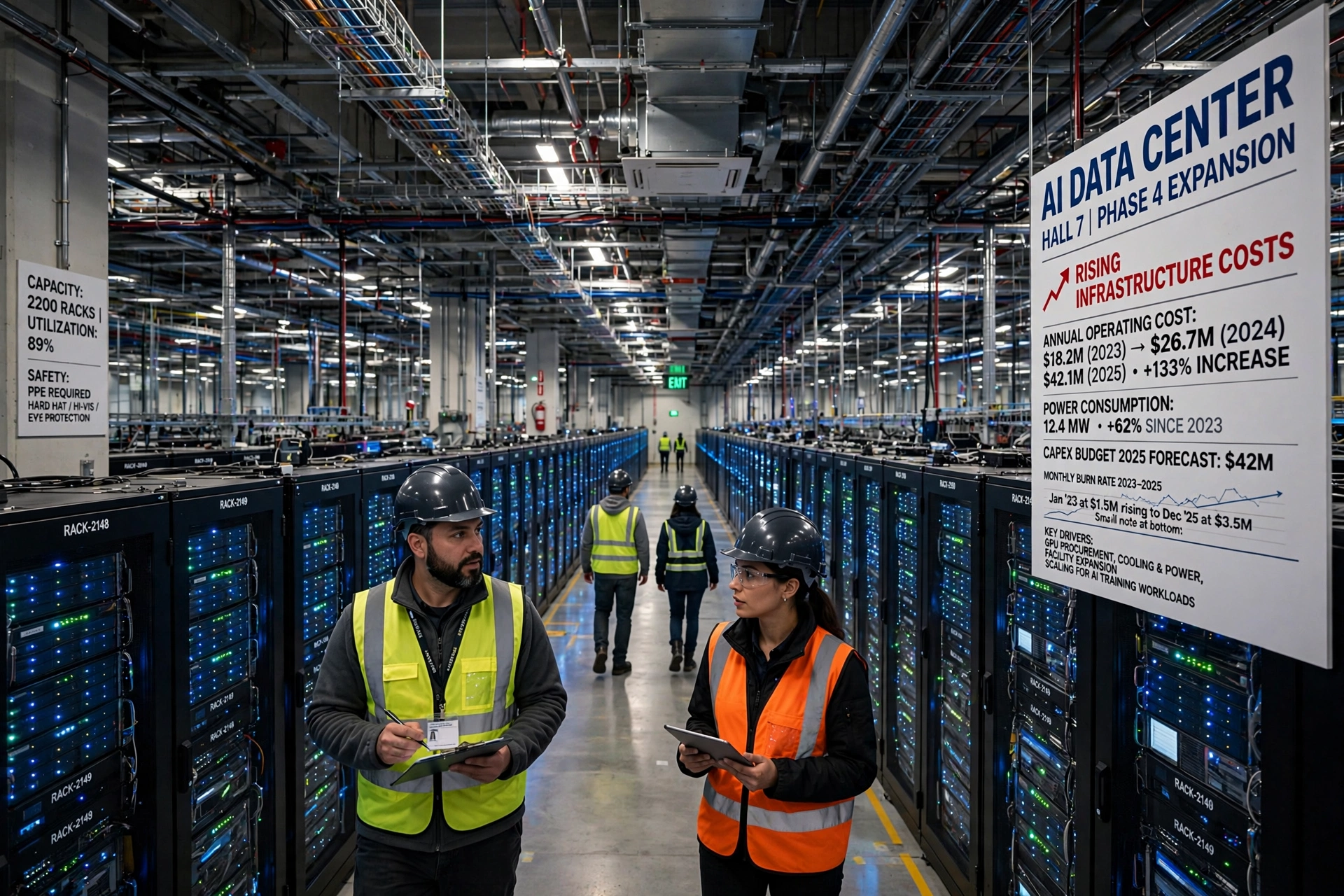
The artificial intelligence boom has a physical side that is easy to forget behind chat windows and image generators: vast data centers, filled with power-hungry chips, rising on industrial land across the United States and beyond. This week, fresh analysis of the industry’s finances has sharpened an uncomfortable question that investors and policymakers are asking with growing urgency — the maths of the AI build-out is not adding up as neatly as the headlines suggest.
Forecasts for spending on AI infrastructure continue to climb, while the revenue expected to pay for that infrastructure grows more slowly. One widely discussed assessment, covered by The Register, puts the imbalance in stark terms: paying for the planned wave of data centers at current trajectories would require an economic output on a scale the labour market simply does not have. Whether or not the exact figures prove right, the direction of travel is hard to dispute — capital is moving faster than proven returns.
A Build-Out Measured in Hundreds of Billions
Technology giants and their partners are committing extraordinary sums to land, buildings, cooling systems, grid connections and, above all, advanced processors. Each new generation of AI models demands more computing power than the last, and no major company wants to be caught short of capacity if demand surges. The result is a race in which spending is driven partly by strategy and partly by fear of falling behind rivals.
Data centers also draw enormous amounts of electricity and water, which is why energy agencies now track them as a distinct force in power planning. The International Energy Agency has repeatedly noted that data centre electricity demand is set to grow strongly in the coming years, concentrated in a relatively small number of regions. That concentration creates local pressure on grids, prices and planning systems long before any national revenue figures settle the AI debate.
Where the Revenue Gap Comes From
The core problem is timing and scale. Subscriptions to AI assistants, advertising products and business software licences are growing, but from a far smaller base than the infrastructure bill. Many of the most impressive AI services are still offered cheaply, or free, to win users. Meanwhile the costs — chips that depreciate quickly, expensive energy contracts, specialist staff — are immediate and largely fixed.
There is also a circularity that makes analysts uneasy. Chip makers invest in AI start-ups, which spend the money on cloud capacity, which is bought from technology giants, which buy more chips. Each step records revenue, but the ultimate question — how much outside customers will pay, repeatedly, for AI services — remains only partly answered. Our recent reporting on how e-commerce businesses can grow without overstretching their teams touched on the other side of this story: smaller firms adopting AI tools carefully, paying for clear returns rather than grand promises.
Why This Is Not Simply Another Bubble Story
Sceptics have cried bubble before, and been wrong, because infrastructure that looks excessive in one decade can look prescient in the next. Railways, broadband fibre and cloud computing all went through phases of overbuilding that later generations used productively. AI demand is real: coding assistants, customer support automation, medical and scientific applications, and media tools are already embedded in daily workflows, and usage continues to rise steeply.
The risk is less that AI is useless, and more that the current pace of spending assumes near-perfect outcomes — rapid productivity gains across the whole economy, premium prices that customers accept, and no serious bottlenecks in energy or chip supply. If any of those assumptions slips, the companies carrying the heaviest debt and depreciation costs will feel it first, and the correction could be sharp even while the technology itself keeps improving.
What to Watch Next
Several signals will show whether the maths is improving. Watch whether AI revenue reported by the big cloud providers grows faster than their capital spending; whether businesses renew AI contracts at higher prices after pilot phases end; and whether power utilities can connect new data centers without pushing costs onto ordinary households. Watch, too, for efficiency gains — models that deliver the same quality with far less computing power would ease the pressure on both balance sheets and electricity grids.
The Bottom Line
The AI data center boom is one of the largest infrastructure bets in economic history, and it may yet pay off handsomely. But this week’s analysis is a useful reminder that enthusiasm is not a business model. Until revenue catches up with the concrete, chips and electricity being poured into the ground, the smartest question in technology remains a simple one: who, in the end, pays for all of this — and how much are they actually willing to spend?
