
Humanity has mapped the surface of the Moon in exquisite detail and photographed galaxies billions of light-years away. Yet roughly three-quarters of our own ocean floor remains charted only in the blurriest outline. The deep ocean — cold, dark, crushing and vast — is the largest unexplored territory on Earth, and a global effort is now under way to chart it before climate change and industry transform it beyond recognition.
The numbers are startling. The deep sea covers more than half the planet’s surface and holds mountains taller than Everest, canyons deeper than the Grand Canyon and ecosystems that science has barely begun to catalogue. Most of what we know comes from a handful of expeditions and the fuzzy gravity-based guesses of satellites, which can miss entire seamounts.
Robots are doing what ships cannot
The breakthrough is automation. Fleets of uncrewed surface vessels and autonomous underwater vehicles now cruise for months, sweeping the seabed with multibeam sonar at a fraction of the cost of a research ship. Projects such as Seabed 2030, which aims to deliver a complete map of the ocean floor, coordinate data flowing in from navies, fishing fleets, cable layers and dedicated survey drones.
Each survey turns up surprises: unknown volcanoes, pristine coral gardens, hydrothermal vent fields crawling with species new to science. Biologists estimate that most deep-sea life remains undescribed, and pharmaceutical researchers are already mining vent microbes and sponges for compounds that could become medicines.
Why the map matters now
This is not exploration for its own sake. Accurate seabed maps improve tsunami warnings, guide the laying of the undersea cables that carry the internet, and help predict how ocean currents — the planet’s great heat distribution system — will shift as the world warms. Agencies such as NOAA Ocean Exploration stress that you cannot protect or manage what you have not first measured.
There is also a sharper edge: the deep seabed holds polymetallic nodules rich in cobalt, nickel and other battery metals. Mining companies are pressing to harvest them, while many scientists warn that dredging ecosystems we do not yet understand could destroy them before they are even named. A good map will not settle that argument, but it will at least show what is at stake, trench by trench.
The frontier comes into focus
Progress is real but incomplete. Mapping the shallow coastal zones is advancing quickly; the remote Pacific and Southern Ocean trenches remain stubbornly blank. The cost of finishing the job is estimated in the low billions of dollars — trivial, supporters note, next to what humanity spends exploring other worlds.
Life in the dark is stranger than expected
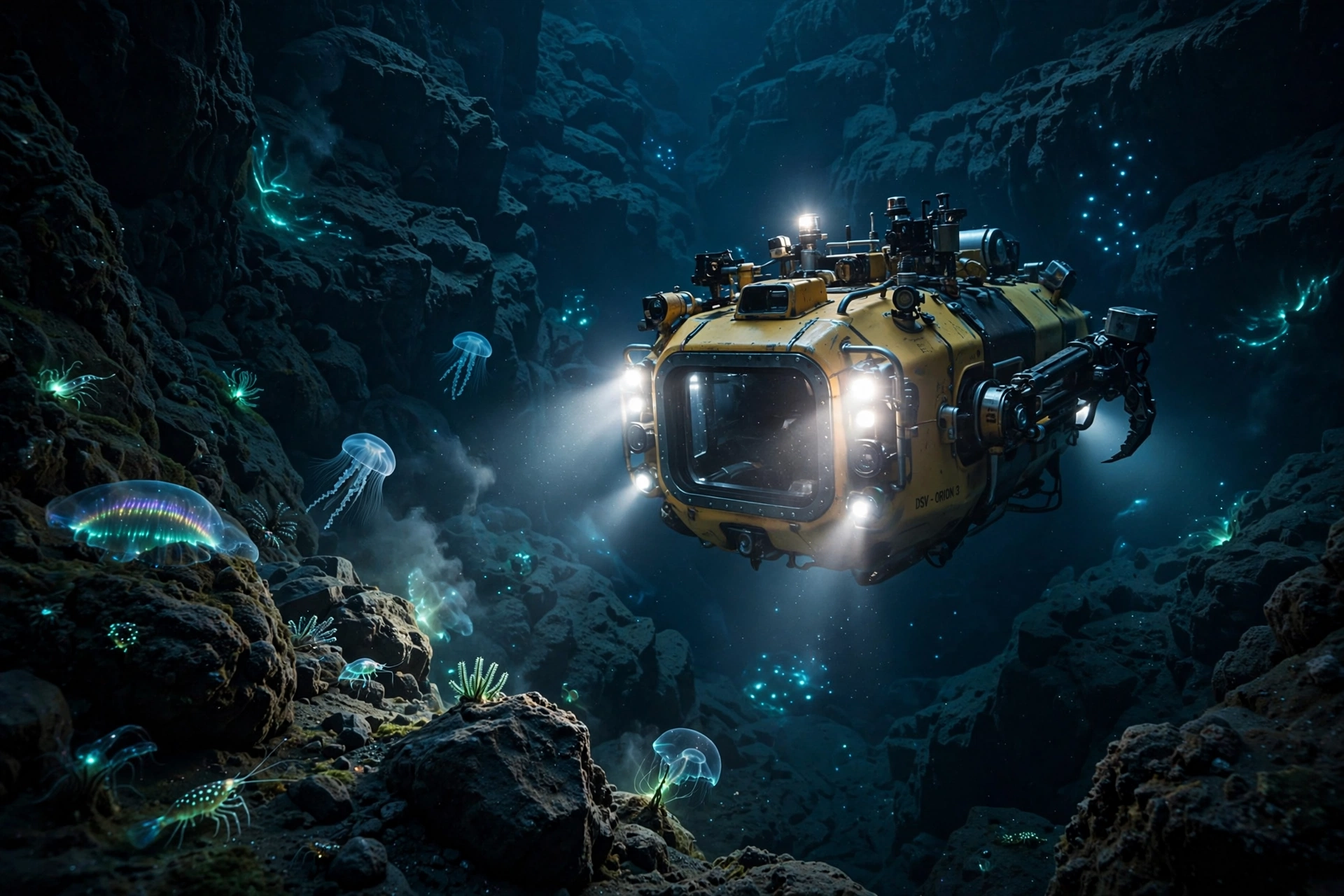
Every mapping expedition doubles as a biological one, and the discoveries keep rewriting textbooks. In the last decade alone, cameras have captured giant squid in their natural habitat, documented fish living kilometres below the limits once thought survivable, and found entire food webs that run not on sunlight but on chemicals seeping from the Earth’s crust. Many deep-sea creatures manufacture their own light, and the enzymes behind that bioluminescence have already found uses in medical research.
The technology enabling this is as impressive as the findings. Pressure at the bottom of the Mariana Trench exceeds a thousand atmospheres, enough to crush a conventional submarine like a drinks can. Modern submersibles use titanium spheres, syntactic foam and robotic arms rated for the abyss, while uncrewed vehicles simply remove the human from the equation altogether. Each dive returns terabytes of imagery that machine-learning systems now help catalogue, flagging possible new species for taxonomists to confirm.
What emerges from the effort is a changed sense of our own planet. The deep ocean is not an empty void but a living, structured landscape that regulates climate, feeds billions and guards most of Earth’s biodiversity. Charting it may be the defining exploration story of this century — and it is happening not on some distant world, but a few kilometres straight down. For more science coverage, read Right Newsletter.
