
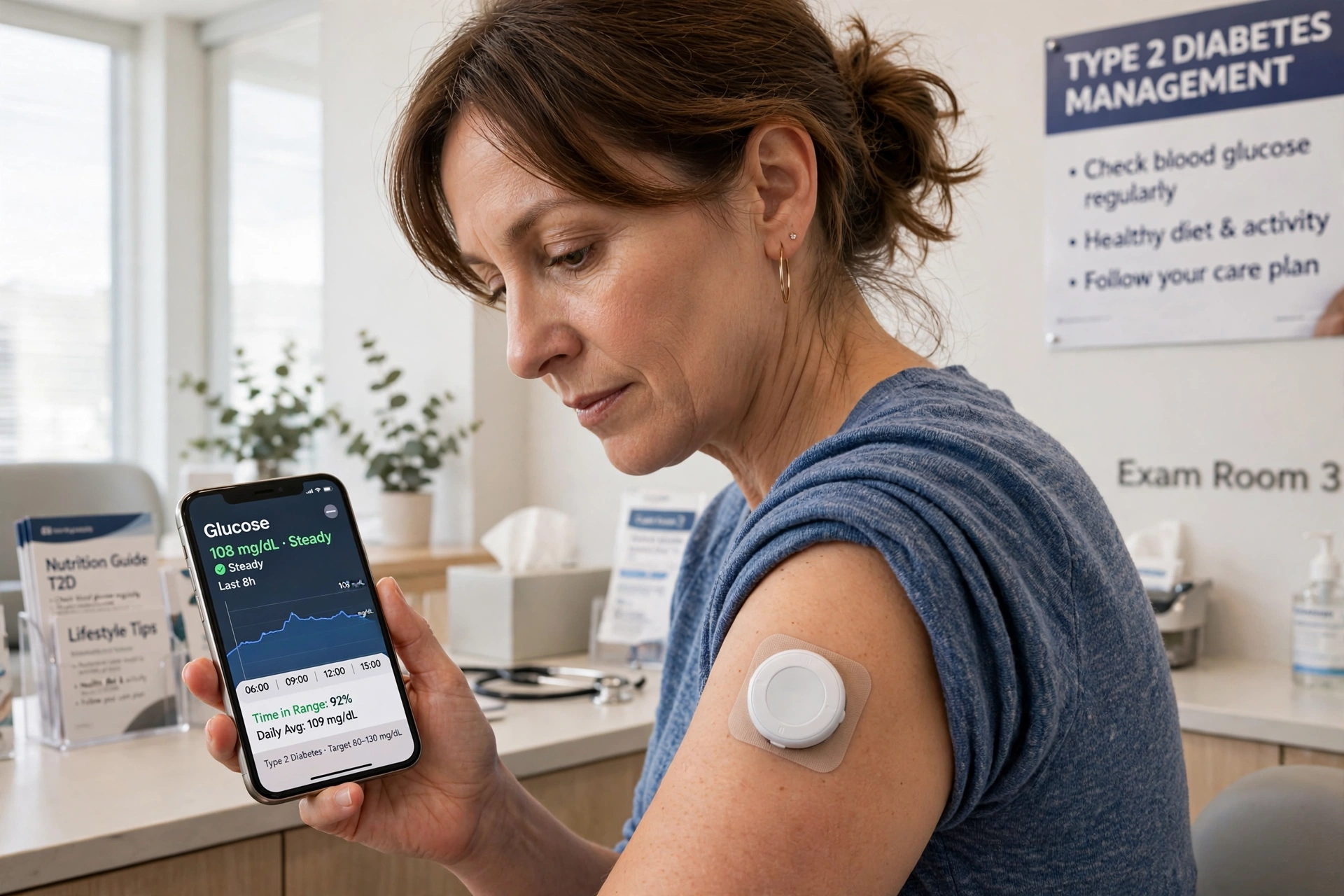
For millions of adults living with type 2 diabetes, the hardest part of the condition is not a single blood sugar reading. It is the hours in between — the long stretches each day when glucose drifts too high or dips too low without any obvious warning. A major new clinical trial, described as the largest of its kind and published in the New England Journal of Medicine, suggests that a small wearable sensor can change that picture in a meaningful way, even for people who do not use insulin.
The study found that adults with type 2 diabetes who used a continuous glucose monitor, or CGM, spent approximately five more hours a day in their target blood sugar range than they otherwise would. Five hours is not a marginal gain. Over weeks and months, time spent in range is closely linked to energy, sleep, mood and, most importantly, the long-term risk of complications affecting the eyes, kidneys, nerves and heart.
What the Trial Found
Continuous glucose monitors are small sensors, usually worn on the upper arm or abdomen, that measure glucose in the fluid just under the skin every few minutes. Unlike a traditional finger-prick meter, which gives a single snapshot, a CGM shows a continuous line: where glucose is now, where it has been, and — crucially — which direction it is heading.
According to the research team behind the trial, that constant feedback helped adults who do not use insulin keep their glucose steadier for roughly five additional hours each day. Coverage of the findings from the University of Colorado Anschutz Medical Campus notes that this population has often been overlooked in glucose-monitoring research, which has historically focused on people with type 1 diabetes or those on intensive insulin therapy.
Why Five More Hours in Range Matters
Diabetes care has traditionally been judged by HbA1c, an average blood sugar measure taken over about three months. Averages, however, can hide wide swings. Two people can share the same HbA1c while one spends most of the day stable and the other cycles between highs and lows. Clinicians increasingly look at “time in range” because it captures those daily patterns that patients actually feel.
Spending more time in range generally means fewer exhausting spikes after meals, fewer crashes, and less cumulative strain on blood vessels. The Centers for Disease Control and Prevention emphasises that keeping blood sugar within a target range as much as possible helps delay or prevent serious complications, including heart disease, vision loss and kidney disease. A gain measured in hours per day, repeated every day, is therefore clinically significant rather than merely statistical.
How Feedback Changes Behaviour
Perhaps the most interesting lesson from the trial is not the sensor itself, but what people do with the information it provides. When someone can see, within minutes, how a particular meal, a short walk after dinner, stress or a poor night of sleep affects their glucose, abstract advice becomes personal evidence. Many users report that they adjust portion sizes, swap one food for another, or add brief activity after meals — small changes that are far easier to sustain than sweeping overhauls.
That learning loop may explain why benefits appeared in people who were not using insulin. The device was not automatically dosing medicine; it was informing everyday decisions. For readers who enjoy following how measurement tools are reshaping other fields, our recent science coverage of mapping the deep ocean, the new race to chart the last unexplored frontier, shows a similar pattern: better data, gathered continuously, changes what experts can do next.
Who Is Most Likely to Benefit?
The findings strengthen the case for wider CGM access among adults with type 2 diabetes whose glucose remains above target on oral medication alone, who experience unexplained fluctuations, or who simply cannot tell from symptoms where their levels are. They also raise practical questions that patients should discuss with their care teams: whether insurance covers a sensor for their situation, how to interpret trend arrows rather than react to every small movement, and how to set realistic alarms so the stream of data informs rather than overwhelms.
CGMs are not a substitute for medication, nutrition, activity or medical follow-up, and sensors carry costs and occasional accuracy quirks, particularly in the first hours of wear. Nor is more data automatically better for everyone; some people find constant readings anxiety-provoking. The trial does not argue that every person with type 2 diabetes must wear one tomorrow. It argues, with unusually strong evidence, that the option should no longer be dismissed for people who do not inject insulin.
The Bottom Line
Type 2 diabetes management is slowly shifting from occasional snapshots to continuous understanding. The largest trial of its kind now shows that shift can deliver about five more hours a day in a healthy glucose range for adults who do not use insulin — time that adds up to better days now and, very plausibly, fewer complications later. For patients who feel they are managing their condition in the dark, that is a powerful reason to ask their doctor a simple question: would a continuous glucose monitor help me?
