
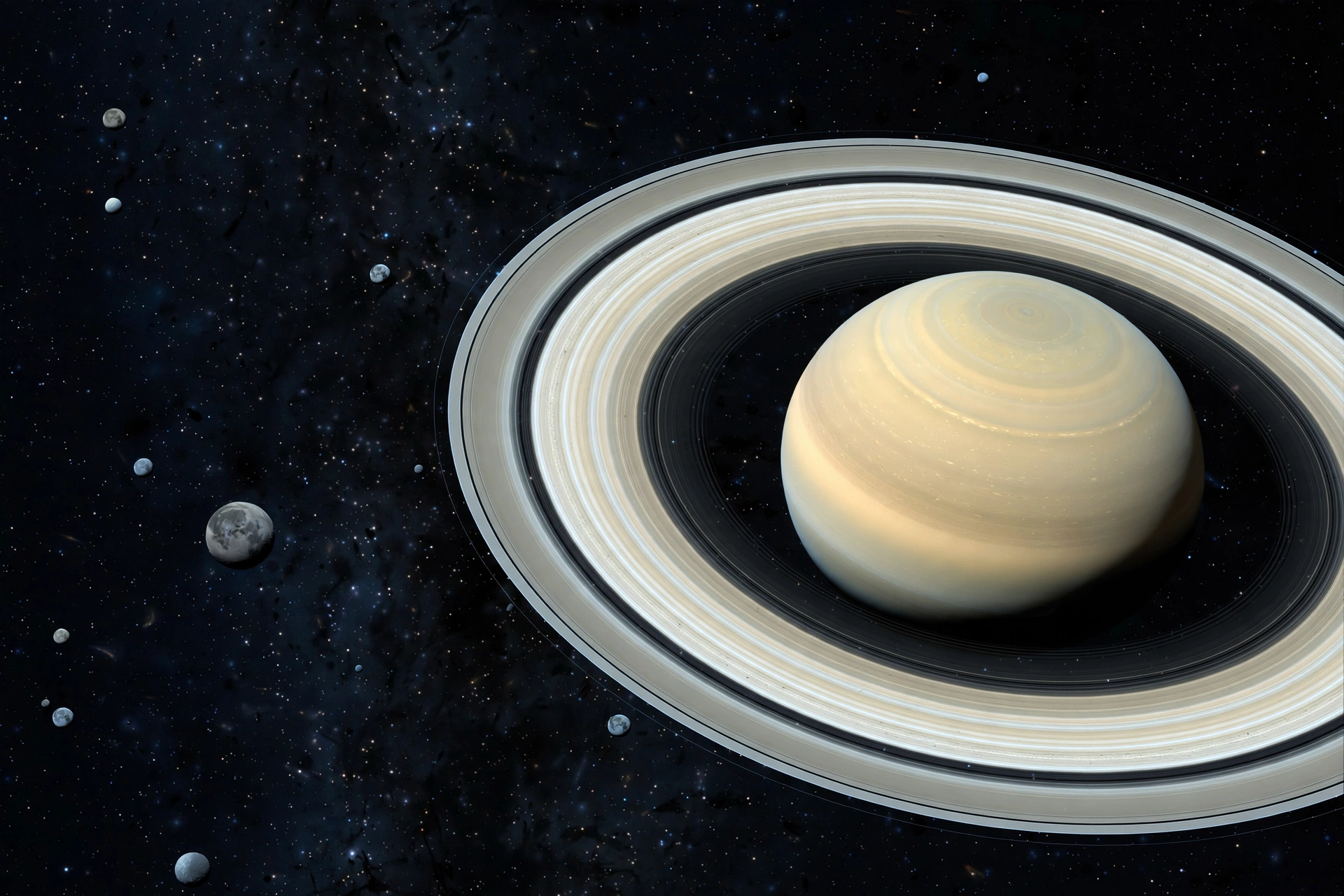
This week’s science briefing begins 1.2 billion kilometres away. Astronomers have formally confirmed 128 new moons of Saturn, which means the planet now has 274 recognised satellites, more than any other world in the solar system. The confirmations, recognised by the International Astronomical Union, close years of follow-up observations and give planetary scientists a far richer picture of how Saturn’s vast retinue of small bodies formed and evolved over time.
From faint smudges to confirmed moons
Detection relied on a technique astronomers call shift-and-stack. Dozens of images from the Canada-France-Hawaii Telescope were aligned on Saturn’s motion and combined, building up signal from objects far too dim to see in any one frame. Each candidate then had to be tracked repeatedly, its path refined observation by observation, until its orbit around Saturn was secure enough to present for formal recognition by the International Astronomical Union, the body that keeps the official catalogues.
What irregular orbits reveal
Unlike the smooth, orderly moons close to Saturn’s rings, these distant objects follow eccentric, inclined paths — the signature of bodies captured or broken up early in the planet’s history. Several of the new moons fall into known collisional families, groups whose members share orbital characteristics because they were once joined. Each addition sharpens the family tree, helping researchers estimate when the parent moons broke apart and how debris spreads around a giant planet over immense spans of time.
It sits comfortably alongside our other recent reporting, including this look at how fast-moving technology is changing business, as another example of patient work producing striking results.
A census that keeps changing
Formal recognition matters because it turns a candidate into a permanent part of the scientific record. The International Astronomical Union confirmed the 128 moons after reviewing the orbital evidence, a step reported widely, including by outlets that follow research news such as Nature. With 274 moons, Saturn now leads Jupiter by a wide margin, and astronomers say the contest between the two giants is effectively settled for the foreseeable future, barring an unexpected surge of discoveries closer to home.
It is worth pausing on the sheer scale involved. Many of the 128 newcomers are only a few kilometres wide — mountain-sized rocks travelling around a planet more than a billion kilometres from the Sun, in darkness, at distances from Saturn far greater than the gap between Earth and its own Moon. Detecting something that small and faint, then following it long enough to prove it belongs to Saturn, is a triumph of instrumentation and persistence. The survey behind the confirmations reflects years of coordinated observing time, data processing and checking, the unglamorous groundwork on which every spectacular space headline quietly depends.
Why this research matters
Further discoveries are likely as instruments improve and archived images are mined with better software. Some of the newly confirmed moons may eventually receive names drawn from mythology, following the conventions used for earlier Saturnian satellites. Until then, the headline stands: 274 moons, one extraordinary planet, and a survey team whose patience has rewritten the record books. It is the kind of result that justifies every cold night spent on a Hawaiian mountaintop checking the same faint points of light.
Naming will come later for many of these worlds. Saturn’s moons traditionally take names from mythology, with irregular moons often drawn from Inuit, Norse and Gallic traditions, chosen under guidelines overseen by the International Astronomical Union. That process can take years, and for now most of the newcomers carry provisional designations — strings of letters and numbers that record when they were first seen. Even unnamed, they matter: their orbits preserve evidence of impacts and captures from the solar system’s youth, a forensic record written in gravity that scientists are only now learning to read in full.
Further background on the institutions behind the survey is available from the University of British Columbia, while Nature remains a useful route into peer-reviewed astronomy reporting.
